Everyday Things That Can Temporarily Raise Blood Pressure
Last Updated
Apr 11, 2026
Many people think of high blood pressure as something that develops due to age, lifestyle, or health conditions. While that’s often true, blood pressure can also change throughout the day.
Your daily habits and surroundings can affect your blood pressure, which may help explain why readings vary from one moment to the next.
Over-the-Counter Medications and Supplements
Some common medications can raise blood pressure without people realizing it.
Decongestants
Decongestants found in many cold and flu medications—such as pseudoephedrine—can cause blood vessels to narrow. This narrowing can increase blood pressure, even in people who don’t usually have high readings.
Decongestants are often included in multisymptom medications, too, making it easy to take them without noticing.
Pain relievers
Nonsteroidal anti-inflammatory drugs (NSAIDs), like ibuprofen and naproxen, can raise blood pressure in some people. These medications can lead to fluid and sodium retention, which increases pressure inside blood vessels.
Caffeine and Energy Drinks
Caffeinated beverages can affect blood pressure, but not all sources of caffeine act the same way.
Energy drinks
Energy drinks tend to have a stronger effect than coffee. Studies show they can raise blood pressure and heart rate within 1-2 hours. This increase may be due to a combination of caffeine and other ingredients, such as taurine, that can amplify these effects.
Coffee and caffeine
Caffeine can cause a short-term increase in blood pressure. For most people, this rise is small—often around 5 to 10 mmHg—and goes away within a few hours. This effect is typically seen with amounts of caffeine found in about 1-3 cups of coffee.
With regular caffeine use, some people become less sensitive to its effects on blood pressure, so the increase may be smaller or less noticeable.
Because caffeine can affect blood pressure readings, many clinicians suggest avoiding it for about 30 minutes before a blood pressure check.
Cold Temperatures
Cold weather can raise blood pressure through natural body responses that help your body conserve heat.
When exposed to cold:
Blood vessels narrow to conserve heat
Heart rate may increase
Hormone systems that regulate blood pressure become more active
These changes help the body maintain its core temperature. However, they also increase pressure inside blood vessels. Even brief exposure—such as stepping from a warm indoor space into colder outdoor air—can raise blood pressure by about 5-20 mmHg in some people.
Stress and Strong Emotions
Stress can temporarily raise blood pressure.
When you feel stressed, the body releases hormones like adrenaline and cortisol. These trigger the “fight-or-flight” response, a built-in survival system that helps you react quickly to a threat.
As part of this response:
The heart beats faster
Blood vessels tighten
These changes help move more blood to important areas like the muscles and brain so the body can respond quickly—but they also increase blood pressure for a short time. In some cases, the increase can be similar to what you might see during light physical activity.
This can also happen in medical settings. Some people have higher blood pressure readings at a clinic visit because they feel anxious or stressed, even if their blood pressure is usually lower at home. This pattern is sometimes called white coat hypertension and is one example of how stress in the moment can affect a blood pressure reading.
Poor Sleep
Sleep plays an important role in blood pressure.
During healthy sleep, blood pressure naturally drops overnight to give the heart and blood vessels time to rest.
When sleep is disrupted:
Blood pressure may stay elevated at night.
The body’s stress response may remain active.
Conditions like sleep apnea can have a stronger effect. When breathing repeatedly stops and starts during sleep,, oxygen levels drop and the body briefly reacts to restore breathing.This reaction can raise blood pressure. When it happens repeatedly, it can lead to spikes in blood pressure throughout the night.
Alcohol and Certain Foods
Alcohol
Alcohol can affect blood pressure in two phases:
Shortly after drinking, blood vessels may relax.
Several hours later, blood pressure may rise.
This delayed increase occurs because the body senses the initial drop in blood pressure and tries to restore it to a normal level. It activates systems that tighten blood vessels and help retain fluid, which can raise blood pressure several hours later.
Licorice
Natural licorice root contains a compound called glycyrrhizic acid that can affect how the body regulates certain hormones. Normally, an enzyme in the kidneys prevents the hormone cortisol from acting like another hormone that controls salt and fluid balance. Licorice can block this protective enzyme.
When the enzyme is blocked, the body may retain more sodium and water. This added fluid increases blood volume and can tighten blood vessels, raising blood pressure. These effects are more likely with larger amounts or regular intake. These effects are more likely with larger amounts or regular intake.
Licorice root may be found in some products like black licorice candy, herbal teas, and certain supplements. However, not all licorice candy contains real licorice root, so it may not always have the same effect.
What You Do Right Before a Blood Pressure Reading
Even small actions can affect a reading.
Talking, moving, or being active just before or during a measurement can temporarily raise blood pressure.
Examples include:
Walking or climbing stairs
Talking during the measurement
Crossing your legs
Holding your arm up without support
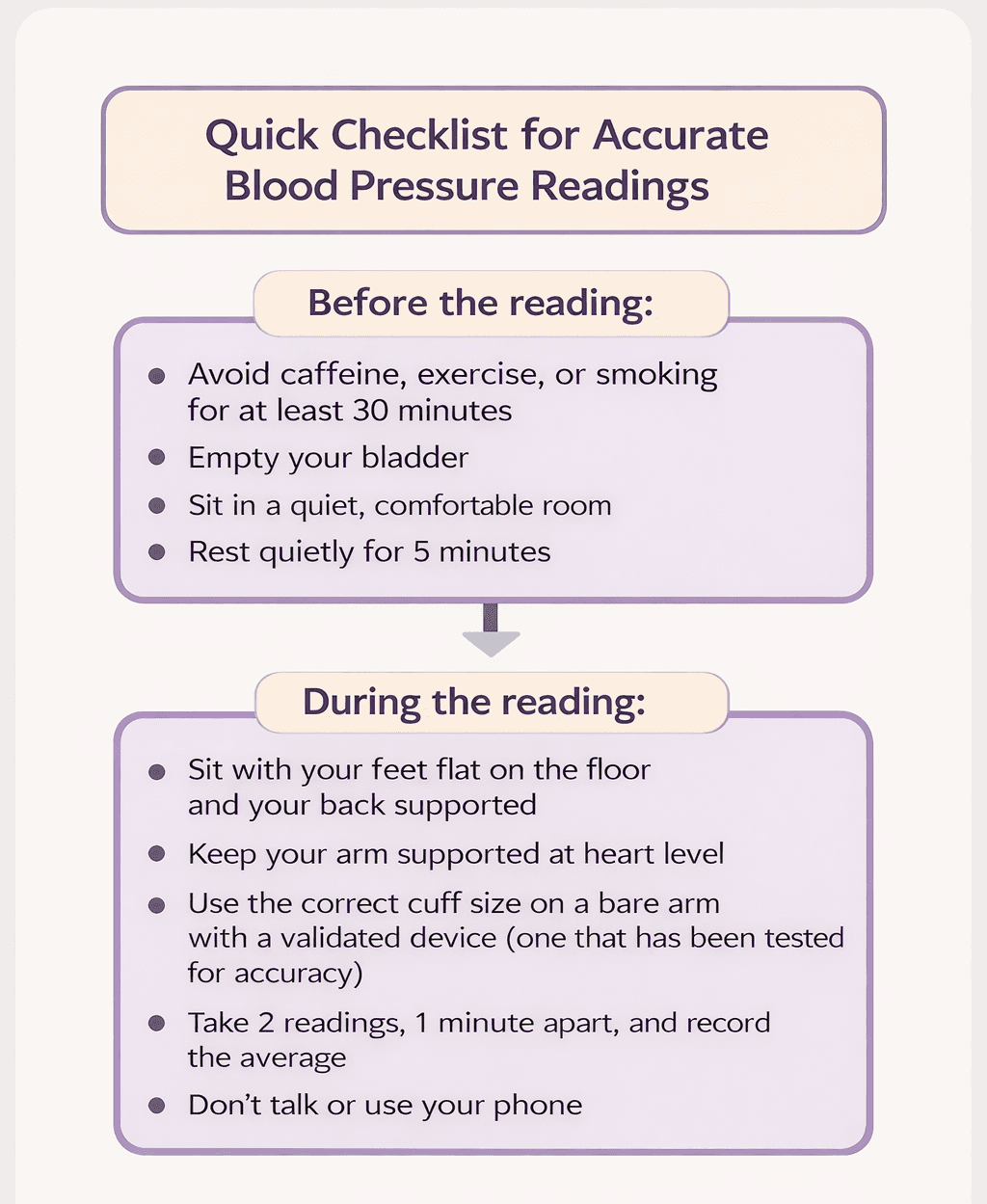
These actions can briefly increase muscle activity or keep the cardiovascular system more active, which can lead to a higher reading. Allowing a few minutes to sit quietly before a measurement can help your body return to a resting state.
Even when you’re doing everything right, how blood pressure is measured can still affect the result. Small things—like cuff size, arm position, or not having time to rest—can change a reading. These steps are part of standard measurement, and your care team plays a role in making sure they’re followed.
If you want a simple guide, you can use this quick checklist—and review our full guide for more detail.
What to Keep in Mind
Blood pressure naturally rises and falls throughout the day. Temporary increases from everyday factors are common and don’t necessarily mean you have high blood pressure.
Understanding how everyday factors affect your blood pressure can help you:
Make sense of individual readings
Understand what may be affecting your numbers day to day
Have more informed conversations with your healthcare team
If there's ever a question about whether a high reading is a one-time occurrence or a consistent pattern, your clinician may suggest monitoring your blood pressure at home across several readings. Reviewing multiple readings can help you better understand what your numbers mean.
References:
af Geijerstam P, Joelsson A, Rådhölm K, Nyström FH. A low dose of daily licorice intake affects renin, aldosterone, and home blood pressure in a randomized crossover trial. Am J Clin Nutr. 2024;119(3):682-691. doi:10.1016/j.ajcnut.2024.01.011.
Casagrande M, Favieri F, Langher V, et al. The night side of blood pressure: Nocturnal blood pressure dipping and emotional (dys)regulation. Int J Environ Res Public Health. 2020;17(23):8892. doi:10.3390/ijerph17238892.
Chan JJ, Chan M, Wright JM. Effect of adrenergic agonist oral decongestants on blood pressure. Cochrane Database Syst Rev. 2025;3. doi:10.1002/14651858.CD007895.pub3.
Chow SL, Bozkurt B, Baker WL, Bleske BE, Breathett K, Fonarow GC, Greenberg B, et al; on behalf of the American Heart Association Clinical Pharmacology Committee and Heart Failure and Transplantation Committee of the Council on Clinical Cardiology, Council on Epidemiology and Prevention, and Council on Cardiovascular and Stroke Nursing. Complementary and alternative medicines in the management of heart failure: a scientific statement from the American Heart Association. Circulation. 2022;147(2). doi:10.1161/CIR.0000000000001110.
Fuchs FD, Fuchs SC. The effect of alcohol on blood pressure and hypertension. Curr Hypertens Rep. 2021;23(42). doi:10.1007/s11906-021-01163-0.
Javaheri S, Javaheri S, Somers VK, et al. Interactions of obstructive sleep apnea with the pathophysiology of cardiovascular disease, part 1: JACC state-of-the-art review. J Am Coll Cardiol. 2024;84(13). doi:10.1016/j.jacc.2024.07.012.
Jones DW, Ferdinand KC, Taler SJ, Johnson HM, Shimbo D, Abdalla M, Altieri M, et al. 2025 AHA/ACC/AANP/AAPA/ABC/ACCP/ACPM/AGS/AMA/ASPC/NMA/PCNA/SGIM guideline for the prevention, detection, evaluation, and management of high blood pressure in adults: a report of the American College of Cardiology/American Heart Association Joint Committee on Clinical Practice Guidelines. J Am Coll Cardiol. 2025;86(18). doi:10.1016/j.jacc.2025.05.007.
Makarem N, Alcántara C, Williams N, Bello NA, Abdalla M. Effect of sleep disturbances on blood pressure. Hypertension. 2021;77(4). doi:10.1161/HYPERTENSIONAHA.120.14479.
Morris DJ, Brem AS, Odermatt A. Modulation of 11β-hydroxysteroid dehydrogenase functions by the cloud of endogenous metabolites in a local microenvironment: the glycyrrhetinic acid–like factor (GALF) hypothesis. J Steroid Biochem Mol Biol. 2021;214:105988. doi:10.1016/j.jsbmb.2021.105988.
Mugele H, Marume K, Amin SB, Possnig C, Kühn LC, Riehl L, Pieper R, Schabbehard EL, Oliver SJ, Gagnon D, Lawley JS. Control of blood pressure in the cold: differentiation of skin and skeletal muscle vascular resistance. Exp Physiol. 2022. doi:10.1113/EP090563.
Piano MR, Marcus GM, Aycock DM, Buckman J, Hwang CL, Larsson SC, Mukamal KJ, Roerecke M; on behalf of the American Heart Association Council on Lifestyle and Cardiometabolic Health, Council on Cardiovascular and Stroke Nursing, Council on Clinical Cardiology, and Stroke Council. Alcohol use and cardiovascular disease: a scientific statement from the American Heart Association. Circulation. 2025;152(1). doi:10.1161/CIR.0000000000001341.
van Dam RM, Hu FB, Willett WC. Coffee, caffeine, and health. N Engl J Med. 2020;383(4):369-378. doi:10.1056/NEJMra1816604.
Keep a Pulse on Progress
Explore our community and collaborate to build and utilize top-tier, trustworthy, and balanced medical education
