Arterial vs. Venous Blood Clots: What’s the Difference?
Last Updated
Feb 19, 2026
Not all blood clots are the same. Some form in arteries, while others form in veins. Understanding the difference between arterial and venous blood clots can help explain why conditions like heart attack and stroke differ from deep vein thrombosis (DVT) and pulmonary embolism (PE).
For American Heart Month in February and Blood Clot Awareness Month in March, we’re highlighting the close connection between blood clots and heart health.
Although both types involve the circulatory system, they develop in different ways and are linked to different health problems, with some overlap in risk factors.
What Are Arterial Blood Clots?
Arterial blood clots form in arteries, the blood vessels that carry blood away from the heart to the rest of the body, including the heart muscle and brain. These clots develop in areas where blood is usually moving quickly and under higher pressure.
Arterial clots often develop after damage to the inner lining of an artery. A common trigger is the rupture of atherosclerotic plaque, which is fatty buildup inside the artery wall. When plaque ruptures, it exposes the vessel wall and causes platelets to rapidly clump together and form a clot, even while blood continues to flow.
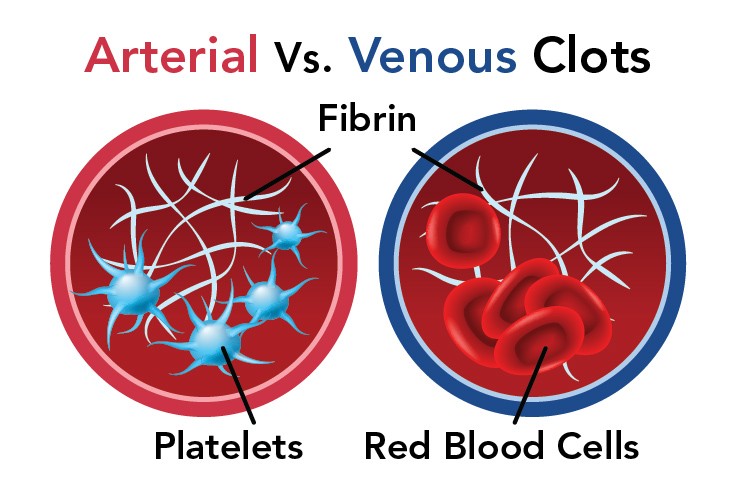
Arterial clots are rich in platelets and fibrin. These clots play a central role in heart attacks and ischemic strokes, which occur when blood flow to the heart or brain is suddenly blocked.
Certain heart conditions can also increase the risk of arterial clots. For example, atrial fibrillation can cause blood to pool inside the heart, where a clot may form and later travel to the brain, leading to a stroke. Long-standing risk factors like high blood pressure, diabetes, high cholesterol, and smoking further damages blood vessels and promotes plaque buildup over time.
What Are Venous Blood Clots?
Venous blood clots form in veins, the blood vessels that carry blood back to the heart and lungs. They usually develop when blood flow slows or pools, most often in the deep veins of the legs or pelvis. When a clot forms in these veins, it's called a DVT. When part of the clot breaks loose and travels to the lungs, it's called a PE. Together, DVT and PE are referred to as venous thromboembolism (VTE).
When a clot forms in a vein, it can block blood flow and cause symptoms like swelling or pain. Venous clots are rich in fibrin and red blood cells, with fewer platelets than arterial clots. This composition is linked to slower-moving blood and helps explain why venous clots often form during periods of limited movement. Things like prolonged immobility, recent surgery, illness, or certain medical conditions can increase the risk of venous blood clots.
What This Means for You
Understanding whether you’ve had an arterial or venous clot can help you:
Better understand your diagnosis
Ask more informed questions
Follow the prevention or treatment plan that’s right for you
Arterial and venous blood clots develop through different processes and affect the body in different ways. Recognizing those differences helps explain why conditions like heart attack, stroke, DVT, and PE are related—but not the same.
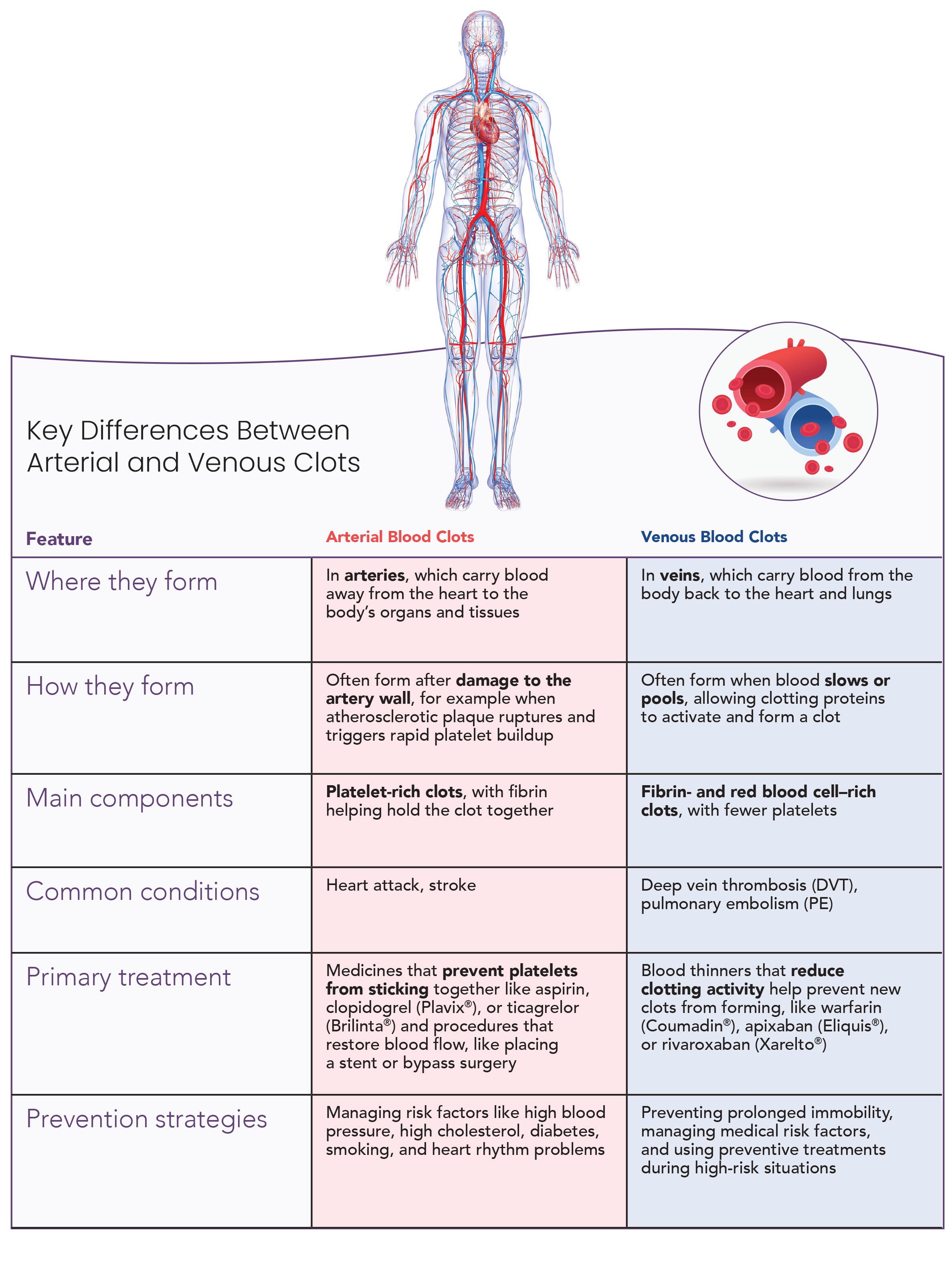
Key Differences Between Arterial and Venous Blood Clots
The graphic above highlights the main differences between arterial and venous blood clots. In general:
Arterial blood clots:
Form in arteries
Develop in fast-moving, high-pressure blood flow
Are often triggered by plaque rupture
Are rich in platelets
Are commonly linked to heart attack and ischemic stroke
Venous blood clots:
Form in veins
Develop when blood flow slows or pools
Are often associated with immobility or recent surgery
Are rich in fibrin and red blood cells
Are commonly linked to DVT and pulmonary embolism (PE)
References
Chernysh IN, Nagaswami C, Kosolapova S, et al. The distinctive structure and composition of arterial and venous thrombi and pulmonary emboli. Sci Rep. 2020;10:5112. doi:10.1038/s41598-020-62025-x
Dawson LP, Lum M, Nerleker N, et al. Coronary atherosclerotic plaque regression: JACC state-of-the-art review. J Am Coll Cardiol. 2022;79(1):66-82. doi:10.1016/j.jacc.2021.10.035
Schulman S, Makatsariya A, Khizroeva J, Bitsadze V, Kapanadze D. The basic principles of pathophysiology of venous thrombosis. Int J Mol Sci. 2024;25(21):11447. doi:10.3390/ijms252111447
Yamashita A, Asada Y. Underlying mechanisms of thrombus formation/growth in atherothrombosis and deep vein thrombosis. Pathol Int. 2023;73(2):65-80. doi:10.1111/pin.13305
Keep a Pulse on Progress
Explore our community and collaborate to build and utilize top-tier, trustworthy, and balanced medical education
