
Polluted Air, Hidden Risks to Your Blood Vessels
Last Updated
Aug 14, 2026
For decades, most air pollution research focused on the lungs. Asthma, allergies, and chronic breathing problems were the main concerns.
We now know the effects of air pollution can reach beyond the lungs.
“There is excellent evidence that poor air affects the heart and blood vessels,” said Dr. Scott Woller, a research professor at Intermountain Health who studies air quality and blood clots, and a professor of medicine at the University of Utah Spencer Fox Eccles School of Medicine. “So think of heart attacks and strokes for those patients who are exposed to bad air for long periods of time.”
Research has linked both short-term exposure (over several days) and long-term exposure (over months to years) to cardiovascular problems. The strongest evidence connects poor air quality with a high risk of heart attack and stroke, while studies have also found links to heart failure, certain heart rhythm disorders, and blood clots.
With a growing body of evidence about the health risks associated with air pollution, the American Heart Association and other leading heart health organizations issued a joint statement in 2021 calling for greater research, education, and public awareness. The statement noted that air pollution is still not widely recognized as a risk factor for heart and vascular disease, though there is evidence of harm to the heart and blood vessels even at exposure levels below the limits recommended by the World Health Organization.
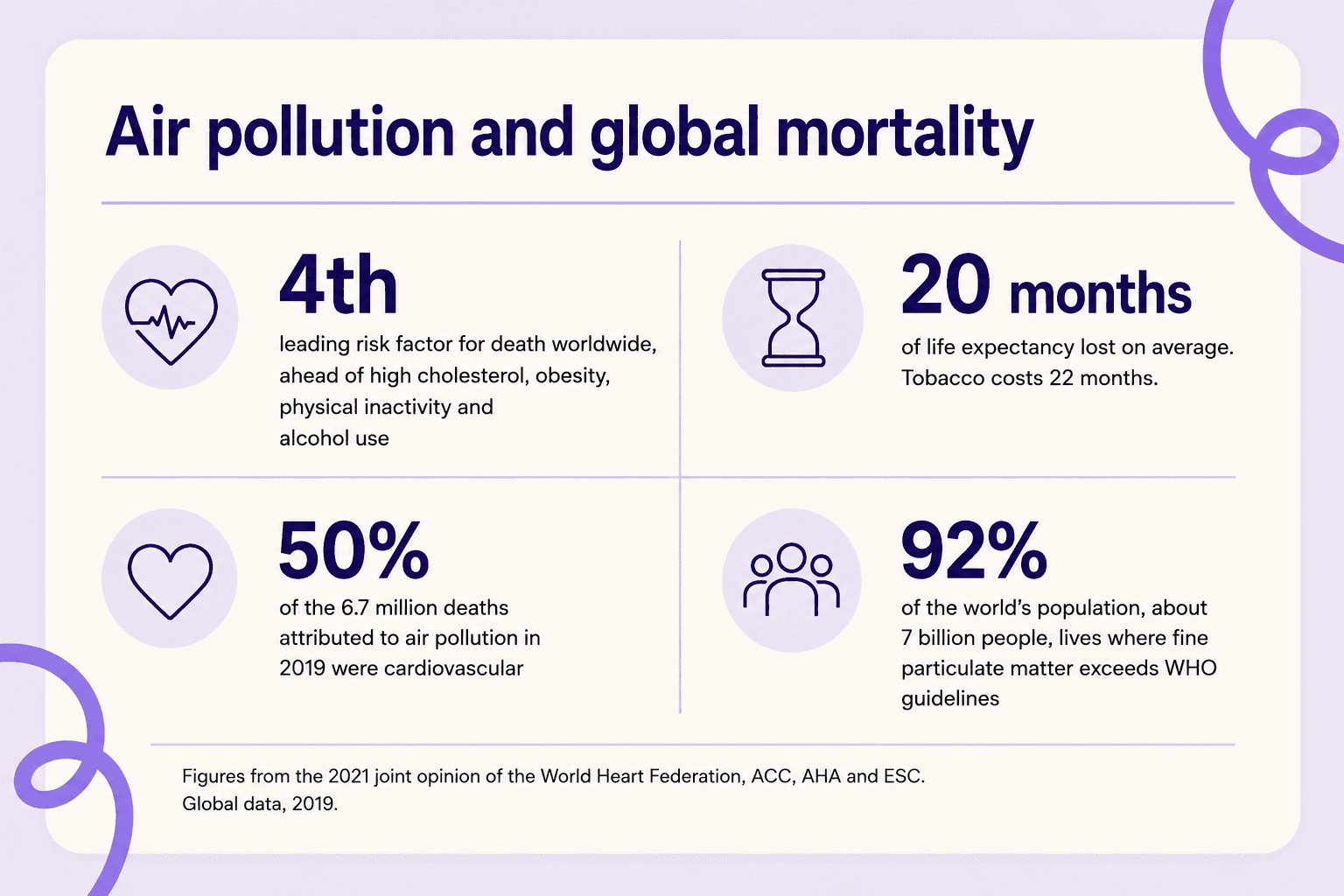
Not All Air Pollution Is the Same
“Air pollution” sounds like one thing but it’s actually a mix of many pollutants. Two are especially important for human health: particulate matter and ozone.
What Is Particulate Matter?
Particulate matter (PM) is a mix of tiny solid particles and liquid droplets in the air. At high levels, you may see it as haze or smoke. Scientists group these particles by size, though most individual particles are too small to see.
PM10 includes particles that are 10 micrometers, or microns, wide or smaller, like dust, pollen fragments, mold spores, and smaller particles.
PM2.5 includes fine particles that are 2.5 microns across or smaller. Common sources include:
Wildfire smoke
Vehicle exhaust
Wood burning and fireplaces
Power plants
Industrial emissions
That scale can be hard to picture. “People can understand the width of a human hair,” Dr. Woller said. He compares the particles with familiar objects to show how small they are.
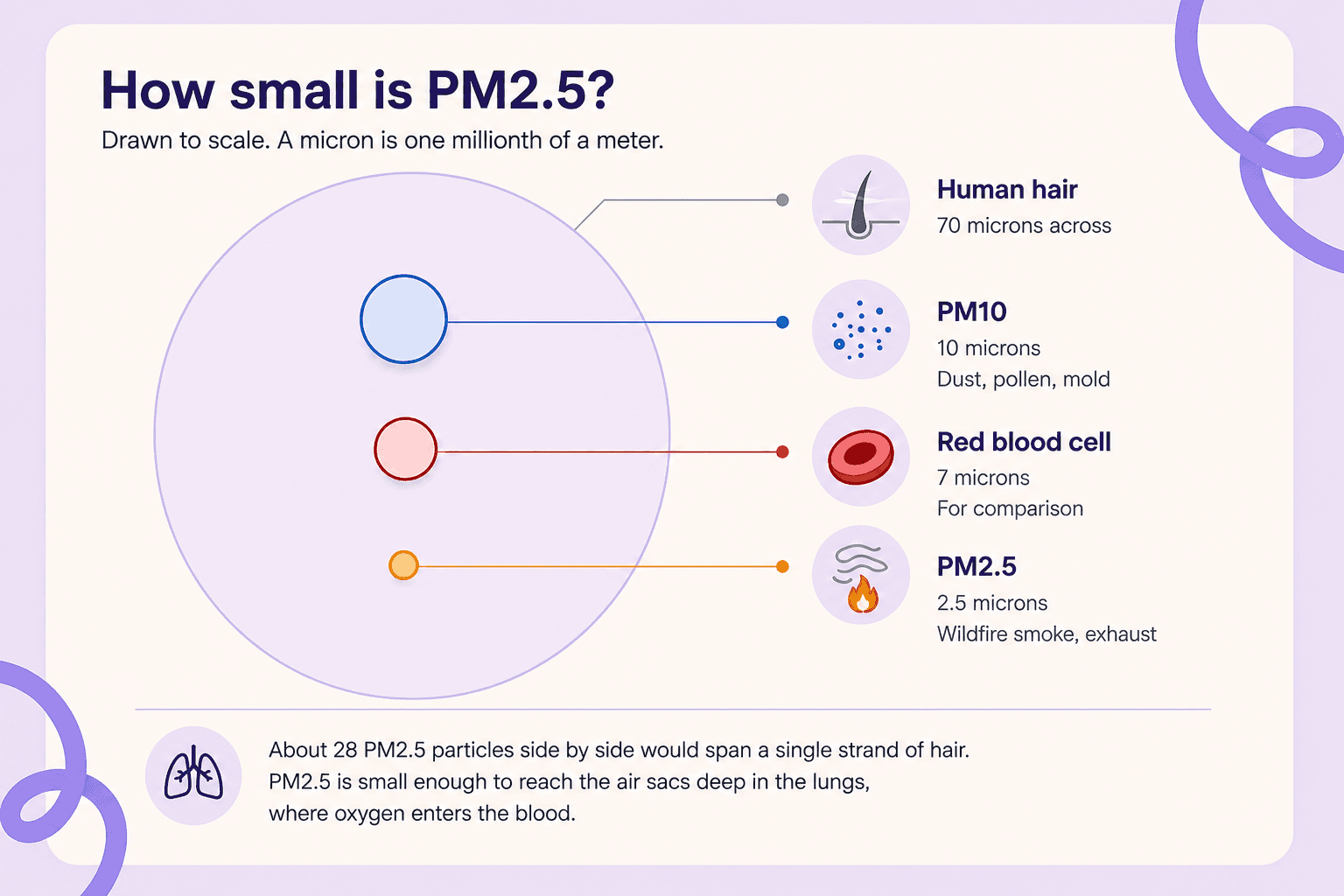
Particle size affects how far it can travel into your body. Larger particles tend to get caught in your nose and upper airways. PM2.5 can travel deep into the lungs, reaching the tiny air sacs where oxygen enters the blood. Some of the smallest particles and the chemicals they carry may also cross into the bloodstream. PM2.5 has the strongest and most consistent evidence for effects on heart and blood vessel health.
What About Ozone?
“Ozone is a gas, whereas PM 2.5 are particles,” Dr. Woller said.
Ground-level ozone doesn’t come directly from one source. It forms when sunlight reacts with pollutants from vehicle exhaust, gasoline vapors, chemical solvents, and industrial facilities. Heat and sunlight increase this reaction, which is why ozone levels often peak on hot, sunny afternoons and tend to be higher in summer.
Ozone mainly affects the lungs. It can irritate the airways and make breathing harder, especially for people with asthma or other lung conditions. Ozone has also been linked to heart and blood vessel problems, although the evidence is weaker than it is for PM.
What Air Pollution Does to Your Blood Vessels
"Bad air leads to inflammation inside our vessels that can increase risk for heart attacks and strokes," Dr. Woller said. That inflammation can make platelets more likely to clump together we believe likely contribute to plaque buildup inside arteries.
Inflammation is part of your body’s normal defense system. When your body detects particles that may be harmful, it responds—and repeated exposure may keep triggering this response, placing extra strain on your heart and blood vessels. Researchers also think polluted air may affect how your body controls heart rate, blood pressure, and blood vessel function.
Repeated exposure to polluted air has been linked to:
Stiffer, less responsive blood vessels
Higher blood pressure
Plaque more likely to break open and trigger a clot
Blood that may clot more easily
The connection between air pollution and clots in the veins is much newer ground.
Clots in the Legs and Lungs
A deep vein thrombosis (DVT) is a blood clot that forms in a deep vein, usually in the leg. If part of the clot breaks loose and travels to the lungs, it can cause a pulmonary embolism (PE), or a blood clot in the lungs. The evidence linking air pollution to DVT and PE remains unclear.
Dr. Woller’s team wanted to know whether just a few days of poor air quality could affect blood clot risk. Salt Lake City offered an ideal place to study that question because the city is situated on the Wasatch Front between two mountain ranges that can trap polluted air for several days.
“That, in effect, forms a “sink”, or some might think of it more graphically as a toilet bowl, where that bad air is accumulating and can’t get flushed out. We’ll have days in a row that have bad air, and then a weather front comes through, clears it out, and we experience good air again,” Dr. Woller said.
Researchers compared hourly air-quality readings with more than 25,500 blood clot cases recorded over 14 years. They looked at whether clots were more likely after periods of poor air quality. The first results, published in 2025, found little evidence for a link between short-term increases in PM2.5 or ozone and blood clots in the general population.
Next, the researchers looked at whether certain health conditions affected the results, including cancer, heart failure, kidney failure, chronic lung disease, plaque buildup in the arteries, and diabetes. Each condition can increase blood clot risk on its own. “Their pump is primed for the formation of blood clots, because they already have the predisposition, and then they are exposed to air pollution,” Woller said.
The researchers looked specifically at ozone exposure within the groups and separated the summer and winter months. They found no association during the winter, when ozone levels tend to be lower. The summer results told a different story. In preliminary findings presented by Dr. Woller (but not yet published), people with kidney failure, atherosclerosis, or chronic lung disease had 7% to 17% higher odds of developing a blood clot following three or seven days of elevated ozone levels in the summer. This finding was not observed among people with cancer, heart failure, or diabetes.
For people with kidney failure, plaque buildup in the arteries, chronic lung disease, or several chronic conditions at once, Dr. Woller recommends paying closer attention to poor-air days. “These results suggest that if you have select or multiple underlying health conditions you would likely benefit from avoiding going outside on these bad air days,” he said, “because you’re at an increased risk for DVT or PE.”
Who May Be Most Vulnerable?
Everyone breathes the same air, but its effects aren’t the same for everyone. People who already have heart or blood vessel disease may be more vulnerable to the effects of air pollution. Higher-risk groups include people with:
Heart failure
High blood pressure
Diabetes
Chronic lung disease
Multiple chronic health conditions
Older adults are also at higher risk. People near busy highways or industrial sites often breathe more polluted air than others.
What Can You Do to Reduce Your Exposure?
Check the Air Quality Index (AQI). It tells you how polluted the air is and which pollutant is the biggest concern that day. That may be PM2.5 during a smoke event or ozone on a hot afternoon. “The AQI is terrific because it provides parameters of how to proceed for sensitive groups,” Dr. Woller said. Depending on where you live, you may be able to check air quality in your immediate area.
Adjust outdoor activity when air quality is poor.
You may want to:
Move a workout indoors
Exercise earlier in the day before ozone levels rise
Save strenuous outdoor activity for a day with better air quality
Choose routes away from heavy traffic
Stay indoors during heavy smoke events
Improve your indoor air.
Keep windows closed when outdoor air quality is poor. If possible, use air conditioning and a portable HEPA air cleaner, which is designed to trap very small particles.
If you have central heating and cooling, consider using a filter rated MERV 7 to 13, or the highest rating your system can safely handle. Higher MERV ratings generally trap smaller particles.
Replace filters according to the manufacturer’s instructions. You can also reduce indoor sources of particle pollution, such as fireplace smoke, candles, incense, and gas cooking.
Keep in mind that HEPA cleaners capture particles, not gases, so they do little on high-ozone days.
Consider an N95 during heavy smoke.
Cloth and surgical masks aren’t built to catch such small particles. An N95 filter removes at least 95% of airborne particles, including those in the PM2.5 range.
For people at higher risk, wearing an N95 is recommended when air quality is poor—but these masks will only work with a proper seal. EPA’s wildfire smoke guidance explains how to check it.
The Bottom Line
Air pollution isn’t a new concern. What is new is our growing understanding of how its effects extend beyond the lungs to the heart, blood vessels, and veins where clots can form. For most people, a single day of poor air quality won’t cause a cardiovascular event. The larger concern is repeated exposure, especially for those who are already at higher risk.
Dr. Woller’s advice is simple: Pay attention to local air quality and use that information when deciding when and how much time to spend outside.
“The major takeaway is that it’s important to be aware that poor air quality is associated with an increased risk for blood clots,” he said. “That awareness can drive behavioral change, that is to say, avoiding exposure. And I’d suggest that if you have underlying health conditions, it’s ideal to understand the air quality and plan your day accordingly because emerging evidence suggests that you’re likely at an increased risk for clots.”
References:
Brauer M, Casadei B, Harrington RA, et al. Taking a stand against air pollution—the impact on cardiovascular disease: a joint opinion from the World Heart Federation, American College of Cardiology, American Heart Association, and the European Society of Cardiology. Circulation. 2021;143(14). doi:10.1161/CIRCULATIONAHA.120.052666.
Rajagopalan S, Landrigan PJ. Pollution and the heart. N Engl J Med. 2021;385(20):1881-1892. doi:10.1056/NEJMra2030281.
US Environmental Protection Agency. Ground-level ozone basics. US Environmental Protection Agency. Updated February 18, 2026. Accessed July 24, 2026. https://www.epa.gov/ground-level-ozone-pollution/ground-level-ozone-basics
Keep a Pulse on Progress
Explore our community and collaborate to build and utilize top-tier, trustworthy, and balanced medical education
