
What's the Difference Between Artery Disease and Vein Disease?
Last Updated
Aug 14, 2026
Problems with the arteries and veins in your legs can look very similar. They may cause the same symptoms—or sometimes no symptoms at all—but have different tests and treatments.
Key Takeaways
Arteries carry blood away from the heart under high pressure. Veins return it under low pressure, working against gravity.
Artery disease keeps blood from reaching your tissues. Vein disease keeps blood from getting back to your heart.
Artery symptoms come on with walking and ease with rest. Vein symptoms do the opposite, easing with movement and elevation.
Symptoms overlap enough that they can’t tell you which one you have. Testing shows whether it’s an artery or a vein.
You can have artery disease and vein disease at the same time.
The treatments aren’t the same. Compression helps vein disease, but it may need to be adjusted or not used at all if you also have artery disease.
Arteries and Veins Have Different Jobs
Arteries: Deliver Blood Throughout the Body
Arteries carry oxygen-rich blood away from the heart and deliver it to your organs, muscles, and other tissues. Because each heartbeat pushes blood through the arteries under high pressure, artery walls are thick, muscular, and elastic. They stretch slightly with each heartbeat and then spring back to their original shape to keep blood moving throughout the body.
Veins: Return Blood to the Heart
Once oxygen has been delivered to your tissues, veins carry blood back to the heart. Veins normally carry blood under much lower pressure and have thinner, stretchier walls, allowing them to hold blood in reserve until your body needs it.
The veins in your legs have one of the most challenging jobs. They have to move blood upward against gravity. When you stand still, pressure inside the leg veins naturally increases, which is one reason your legs may feel heavy or achy after standing for long periods.
To keep blood moving in the right direction, leg veins rely on two features:
One-way valves that prevent blood from flowing backward.
The calf muscles, which act as a second pump. Every time you walk or move your feet and ankles, they squeeze the veins and push blood back toward the heart.
Why Artery and Vein Diseases Are Different
Artery Disease: When Blood Can’t Reach the Tissues
Artery disease (also called arterial disease) usually develops when plaque gradually builds up inside the artery wall, narrowing the space for blood to flow. This buildup is called atherosclerosis. As the artery narrows, less oxygen-rich blood reaches the muscles and other tissues.
When atherosclerosis develops in your leg arteries, it’s called peripheral artery disease (PAD). The same plaque buildup in the heart causes coronary artery disease, and carotid artery disease in the neck. The name changes depending on which artery is affected, but the disease is the same. That’s why people with PAD have a higher risk of heart attack and stroke.
Vein Disease: When Blood Can’t Return to the Heart
Vein disease (also called venous disease) has several possible causes:
Blood flows backward because the one-way valves weaken or begin to leak (a condition called venous reflux).
Blood flow becomes blocked by a clot (called a deep vein thrombosis, or DVT).
Blood moves more slowly when the calf muscles aren't being used regularly, such as during prolonged sitting or other periods of immobility.
Although these problems begin differently, they can all increase pressure inside the leg veins (called venous hypertension).
When that pressure stays high, chronic venous disease develops. Early on, it may cause varicose veins. For some people, it progresses to chronic venous insufficiency (CVI).
A DVT raises that pressure in two ways. The clot blocks blood flow, so pressure builds behind it. And clots don’t always clear completely. What’s left behind, along with damage to the vein’s valves, can keep pressure high long after the clot is treated.
Why Symptoms Can Look Different
Your muscles need oxygen, and they need more of it when you walk. Your muscles won’t get enough oxygen if a narrowed artery can’t deliver it. The result is pain, cramping, aching, or tired legs. Resting lowers the oxygen demand, so the discomfort usually eases.
With vein disease, staying still often triggers symptoms. Pressure builds in the veins, leading to swelling, aching, heaviness, and skin changes. Walking activates the calf muscle pump, and elevating your legs lets gravity help blood return, so symptoms usually ease with movement.
In advanced arterial disease, some people notice that foot pain worsens when the leg is elevated, because gravity is no longer helping blood reach the foot.
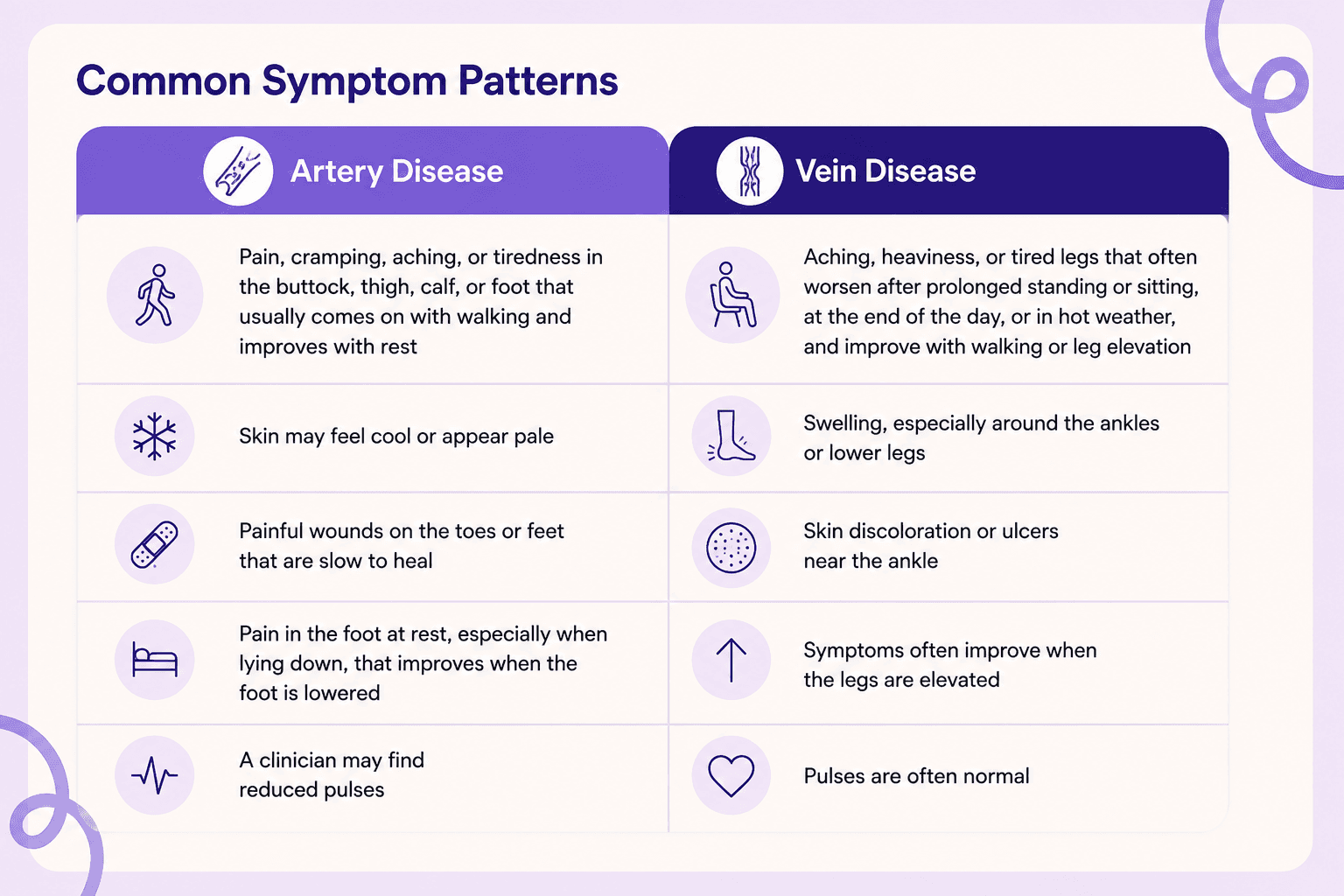
Importantly, these symptoms and patterns don’t affect everyone the same way. Many people with PAD have no obvious symptoms, and a vein’s appearance doesn't always match how it feels. Some people have large varicose veins with few symptoms, while others ache even though their veins look fine.
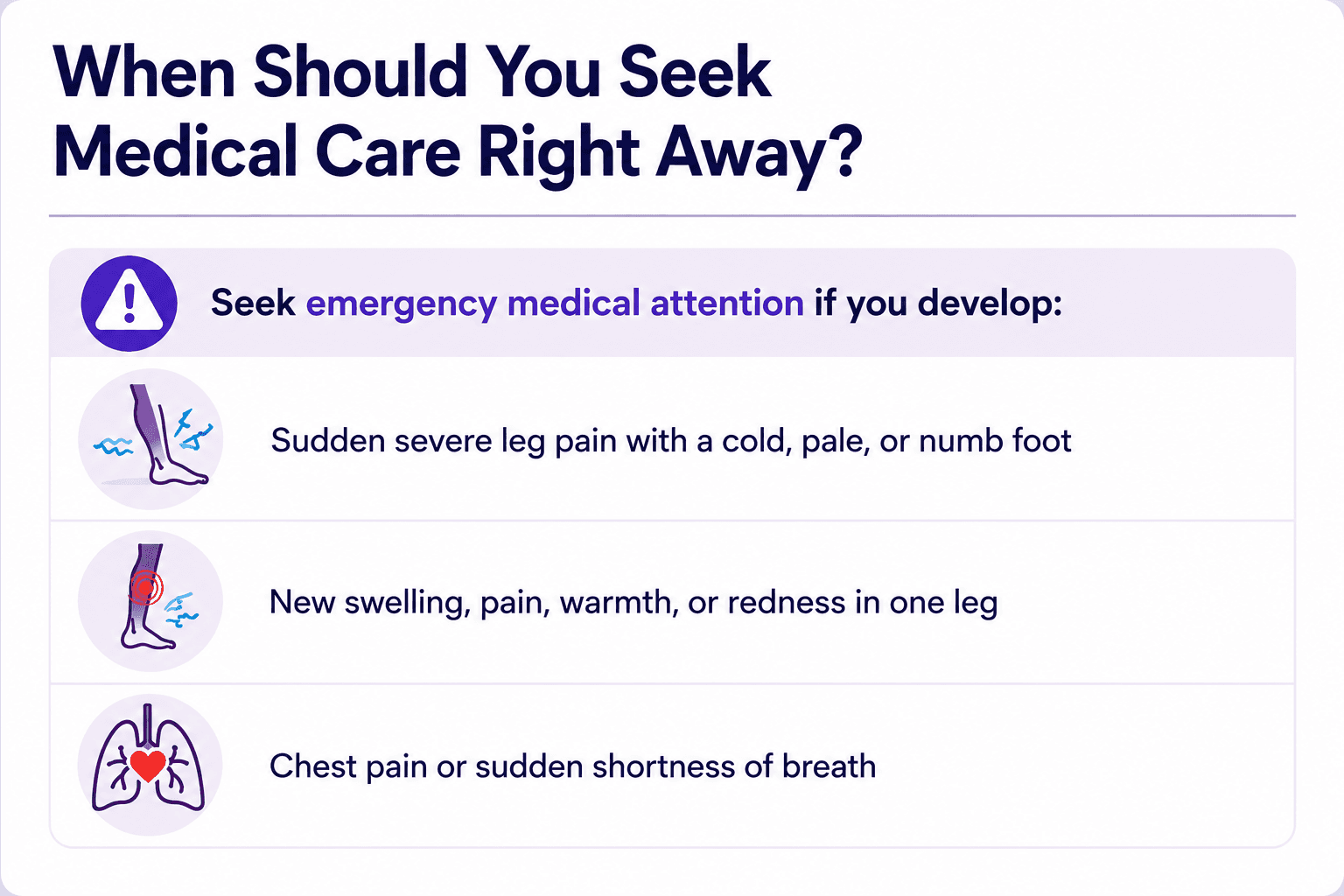
Venous disease can even cause leg pain with walking that resembles artery disease. That’s why symptoms alone don’t tell the full story.
How the Diagnosis Is Made
Testing for Artery Disease
An ankle-brachial index (ABI), a blood pressure test that compares the blood pressure in your ankle and arm to check for reduced blood flow to your legs.
A toe pressure instead, if diabetes or kidney disease makes the ABI unreliable
An arterial ultrasound, to show where blood flow is reduced and how severely
CT or MR angiography, to get a detailed picture of your arteries
Testing for Vein Disease
A venous duplex ultrasound, to check for a clot or leaking valves
CT or MR venography, to get a detailed picture of the deeper veins in your pelvis or abdomen
Why Treatment Depends on the Blood Vessel
Treating Artery Disease
PAD is more than just a circulation problem in the legs; it signals atherosclerosis throughout the body. So treatment protects your whole cardiovascular system rather than just your legs. That usually means:
Statins and other medicines that help prevent clots, such as aspirin
Quitting smoking and keeping blood pressure and blood sugar at healthy levels
A structured walking program
Medical procedures or surgery if symptoms are severe
Treating Vein Disease
Vein disease is usually chronic, meaning it's a long-term condition that may need ongoing treatment. Procedures can treat damaged veins, but they don't always address what's causing pressure to build inside the leg veins in the first place. Treatment focuses on lowering that pressure and keeping it down. That may mean:
Wearing Compression stockings, wraps, or devices
Walking and raising your legs above heart level
Vein procedures, if other treatments don’t work
Taking a blood thinner
Why the Same Treatment Isn’t Right for Everyone
Every situation is different, and what’s right for someone else may not be right for you.
Compression isn’t automatically safe. It helps many people with vein disease, but when someone also has reduced blood flow from artery disease, the type and strength of compression matter. Some people need lower-pressure compression, and those with severely reduced flow may need to avoid compression altogether. That’s why clinicians often check the ABI first.
“Blood thinner” is a common term but it can refer to two different types of medication. In artery disease, platelets can gather where plaque’s broken open and form a clot. Treatment often includes antiplatelet medicine, which helps keep platelets from sticking together. With DVT, a clot can form when blood flow slows or the blood becomes more likely to clot. Treatment usually involves an anticoagulant. Depending on their individual risk, some people with PAD may take low-dose aspirin (an antiplatelet) together with low-dose rivaroxaban (Xarelto®—an anticoagulant).
Can You Have Both Artery and Vein Disease?
Yes, and it’s not unusual to have both. Artery and vein disease can occur together, especially in people who are older or who have obesity or diabetes. Because the two conditions can cause similar symptoms, one type of disease may go unnoticed after the other’s been diagnosed.
An estimated 15% to 30% of leg wounds caused by vein disease also involve artery disease. If the arteries aren’t delivering enough blood, the wound may not heal—no matter how well the vein disease is treated.
If your symptoms aren’t improving, or they don’t seem to line up with your diagnosis, it’s reasonable to ask your care team whether another vascular condition could be contributing.
References
Ammermann F, Meinel FG, Beller E, et al. Concomitant chronic venous insufficiency in patients with peripheral artery disease: insights from MR angiography. Eur Radiol. 2020;30:3908-3914. doi:10.1007/s00330-020-06720-8.
Chopard R, Albertsen IE, Piazza G. Diagnosis and treatment of lower extremity venous thromboembolism: a review. JAMA. 2020;324(17):1765-1776. doi:10.1001/jama.2020.17272.
Gornik HL, Aronow HD, Goodney PP, et al. 2024 ACC/AHA/AACVPR/APMA/ABC/SCAI/SVM/SVN/SVS/SIR/VESS guideline for the management of lower extremity peripheral artery disease: a report of the American College of Cardiology/American Heart Association Joint Committee on Clinical Practice Guidelines. J Am Coll Cardiol. 2024;83(24). doi:10.1016/j.jacc.2024.02.005.
Eikelboom JW, Connolly SJ, Bosch J, et al. Rivaroxaban with or without aspirin in stable cardiovascular disease. N Engl J Med. 2017;377(14):1319-1330. doi:10.1056/NEJMoa1709118.
Nou Howaldt M, Dardik A, Courtois MC, et al. Diagnostic assessment for venous leg ulcers: recommendations from the Wounds and Healing working group of the French Society of Vascular Medicine. Vasc Dis. 2025;50(3-4):127-132. doi:10.1016/j.vasdi.2025.04.001.
Keep a Pulse on Progress
Explore our community and collaborate to build and utilize top-tier, trustworthy, and balanced medical education
