
When Health Information Feels Confusing
Last Updated
Apr 11, 2026
Health information can feel overwhelming. There’s a lot of it online, on social media, and in the news—and not all of it is accurate.
Topics like blood pressure, cholesterol, diet, and exercise can come with advice that sounds different depending on where you look. One source may say one thing, while another suggests something else. It can start to feel like no one agrees.
In reality, experts often agree more than it seems. What can look like disagreement is often just the way information gets shared. Headlines may leave out key details. Social media posts often simplify complex topics. And while medical guidance does change, that usually reflects better research—not confusion.

Why Health Advice Can Sometimes Sound Conflicting
Health recommendations are often made for different audiences.
Public health guidance is general advice meant to help large groups of people improve their health. It often comes from organizations like the Centers for Disease Control and Prevention (CDC) and the American Heart Association (AHA). These messages usually focus on habits that benefit most people, such as staying physically active, eating a balanced diet, and managing risk factors like high blood pressure.
Personal medical advice is different. When a doctor or clinician makes a recommendation for you, they look at the full picture—your age, health history, medications, and overall risk. General guidance isn’t designed to do that.
Because general guidance and personal medical advice serve different purposes, the same evidence can lead to different recommendations. Guidelines are written for large groups of people and focus on what is most likely to help the majority. But when a clinician makes a recommendation, they are focused on you—your health history, your risk factors, and your specific situation.
How Nuance Can Get Lost as Information Spreads
Health research can be complex. Scientific studies include details like how the study was done, its limitations, and explanations that help make sense of the findings.
Research is often more specific than headlines make it sound. A study may focus on one group of people, one condition, or a specific set of circumstances. But that context isn’t always included in news coverage or social media posts. Sometimes findings spread quickly before the full details are widely understood. As a result, health advice can sound more certain or true for more people than the research actually supports.
Not all studies carry the same weight, either. Some look at patterns, while others test what actually causes a change. Studies that directly test cause and effect tend to provide stronger evidence because they can better account for other factors that might influence the results. These differences aren’t always explained when information is shared more widely.
Why Expert Recommendations Can Change Over Time
Medical knowledge continues to grow as researchers study health and disease. As new evidence becomes available, experts will update recommendations to reflect what’s been learned.
This process is a normal and important part of science. Updated guidance often means that researchers have gained a better understanding of risk factors, treatments, or prevention strategies, and have come across new or updated evidence to support this understanding.
Although changes in recommendations can sometimes feel frustrating or confusing, they represent progress in improving patient care.
How to Make Sense of Health Information
When health information feels confusing, a few simple steps can make it easier to understand.
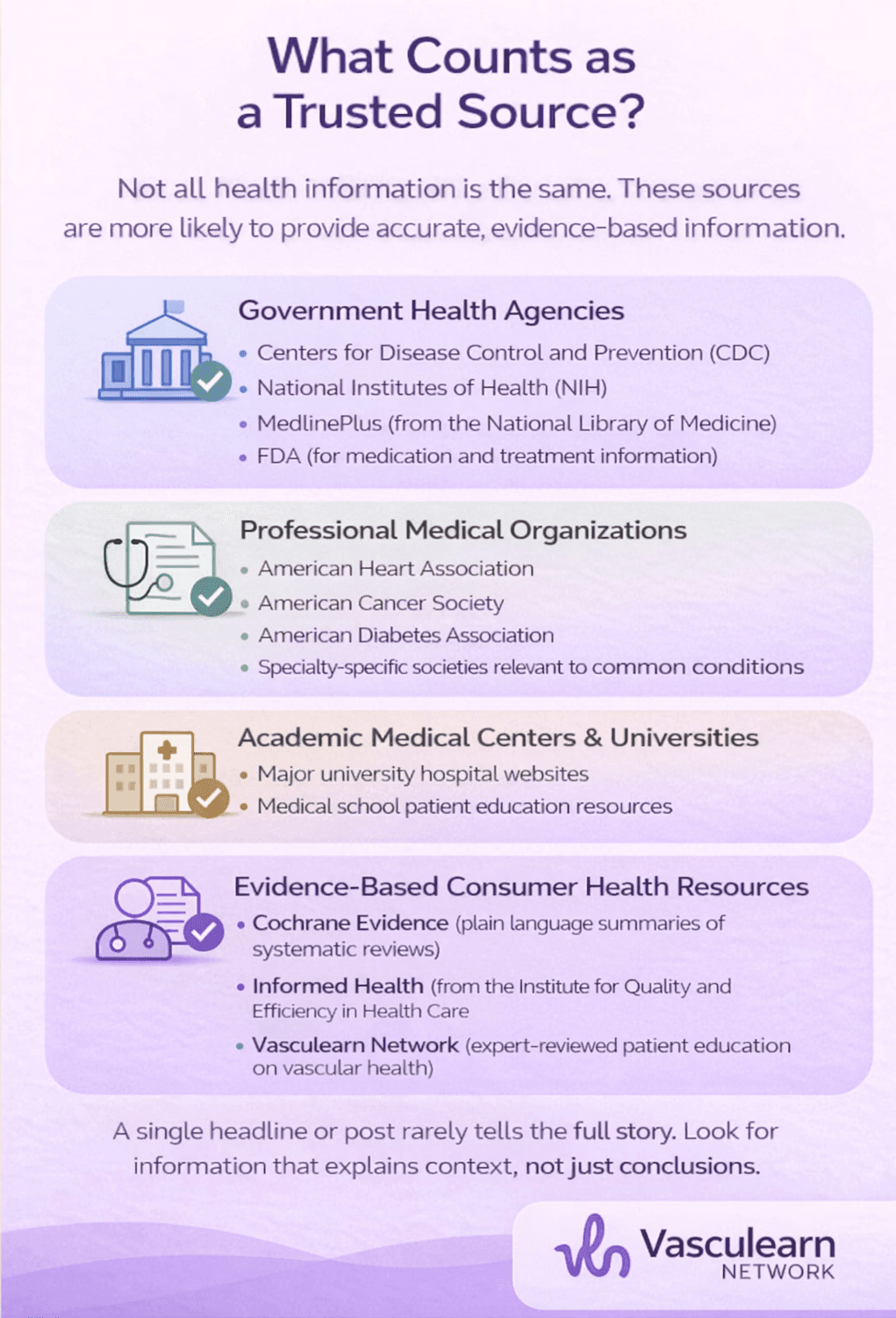
Look for trusted sources. Information from reputable organizations, medical institutions, and your clinician can provide helpful context and more complete explanations.
Remember that headlines don’t tell the whole story. A single headline or study may highlight one finding but rarely captures the full picture of a health topic.
Look beyond the first result. When searching for health information online, the first result or summary may not include the full context. Checking more than one source can give you a clearer picture.
Ask questions when advice feels unclear. Talking with your clinician can help clarify how health information applies to your own situation.
Understand that recommendations can evolve. As researchers learn more about health and disease, guidance will often change. These updates often reflect progress in medical knowledge.
Understanding where health information comes from can make it easier to sort through what you hear or read and focus on what matters for your own health.
References:
Borges do Nascimento IJ, Pizarro AB, Almeida JM, et al. Infodemics and health misinformation: A systematic review of reviews. Bull World Health Organ. 2022;100(9):544-561. doi:10.2471/BLT.21.287654.
Chapman E, Haby MM, Toma TS, et al. Knowledge translation strategies for dissemination with a focus on healthcare recipients: An overview of systematic reviews. Implement Sci. 2020;15(14). doi:10.1186/s13012-020-0974-3.
Manns BJ. Evidence-based decision making 5: Knowledge translation and the knowledge to action cycle. Methods Mol Biol. 2021;2249:467-482. doi:10.1007/978-1-0716-1138-8_25.
Keep a Pulse on Progress
Explore our community and collaborate to build and utilize top-tier, trustworthy, and balanced medical education
